Association theory and social evolution
Explaining kin recognition, association preference, and the evolution of complex social traits.
Association theory distinguishes association preference—differentially entering the contexts for interactions—from differential treatment—helping or harming after association. This distinction makes it possible to reconstruct the evolution of genetic kin recognition as a sequence of changes in interacting traits.
Empirical and intellectual foundations
My empirical research grew out of a question that first arose during my undergraduate years at Yale. In a course taught by Elisabeth Vrba, I learned about the importance of the “units of selection” problem in macroevolution. My impression was that the conundrum could be resolved only through empirical research, although I could not yet see a path forward. I then met Leo Buss and recognized that he had developed both an evolutionary hypothesis and a model system directly relevant to the problem. In particular, a paper in which he described a cheater mutant in social amoebae appeared to provide an opportunity for a key test of theory.
This led me to graduate research combining field and laboratory studies of the social amoeba Dictyostelium discoideum. During its social stage, formerly independent amoebae aggregate to form a multicellular fruiting body in which some cells die to produce a sterile stalk while others become reproductive spores. This division of reproductive roles creates the potential for the evolution of degenerate cheater mutants, which might in turn select for mechanisms of kin recognition and segregation. Buss’s hypothesis was that such mutants would favor recognition mechanisms that allowed different clones to segregate into separate fruiting bodies.
As a graduate student, I found extremely high genetic relatedness in natural fruiting bodies and some evidence of recognition and discriminatory segregation, but no evidence of cheater mutants. Recognition and segregation were therefore evident even though the proposed selective agents were not found. These results led me to examine the underlying theory more closely. Around the same time, theoretical models suggested that even if cheater mutants occurred, they would not provide an evolutionarily stable selective pressure capable of maintaining polymorphic kin-recognition systems. The convergence of these empirical findings and theoretical results led me to search for a different explanation for the evolution of kin recognition. The result was association theory.
From observation to a new evolutionary model
Evidence of recognition and segregation
Some pairs of naturally occurring clones segregated strongly when mixed, demonstrating the potential for kin discrimination. These observations raised the question of what selects for recognition and segregation when cheater mutants are not evident. My later comparative work examined this variation more extensively.

Evidence of discriminatory segregation in D. discoideum. I mixed naturally occurring clones S2-1 and S2-3 at equal proportions and allowed to form fruiting bodies on a sterilized deer pellet or agar. Uniclonal fruiting bodies were found on the deer pellet, but not on agar, suggesting segregation on a natural substrate.
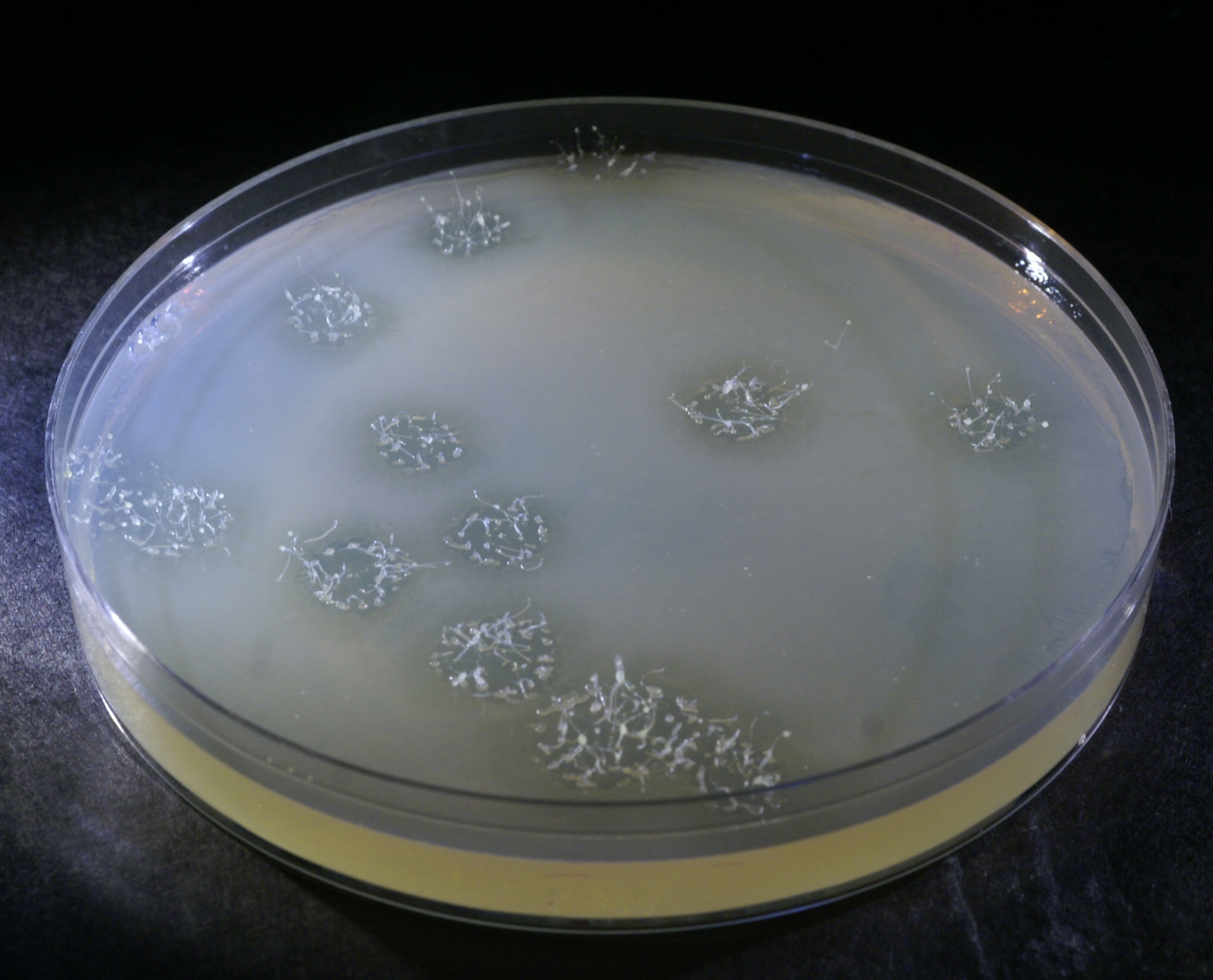
Searching for cheater mutants with clonal isolations. To assess whether cheater genotypes existed in natural populations, I placed the spore masses of 95 natural fruiting into suspension and plated diluted solutions onto agar plates with bacteria. The resulting developmental patters resulting from of over 3000 single-spore isolates were all normal, as in panels A and C (wildtype) rather than B and C (a known cheater, fbxA-).

Example plate. The individual clearings show evidence of normal developmental pattern. Each clearing came from a single spore of a natural fruiting body collected at Mountain Lake Biological Station, Virginia.
A modest overall effect (Figure 3, Gilbert et al. 2012). Segregation significantly increased relatedness relative to the control, but its contribution was small: the median increase attributable to segregation was 0.049, compared with 0.001 without development. Thus, the ability of some clone pairs to segregate strongly did not imply a strong overall effect among naturally occurring clones. Read the study.
Association preference and differential treatment
My model separates two kinds of discriminatory behavior: how organisms treat one another and whether they associate. Differential treatment can change the reproductive consequences of entering an association, thereby selecting for association preference. Genetic cues used in these two behaviors need not be the same.
I first submitted this model in 2009 and subsequently developed it for application to histocompatibility in marine invertebrates. The historical model was published in 2015; the 2017 association-theory preprint presents the broader framework.
Predictions
Separate cues for separate behaviors
Genetic kin recognition requires both a perception mechanism and a cue. Extreme cue polymorphism makes it unlikely that unrelated organisms will share the same cue. My model showed that adaptive evolution of this polymorphism requires separate cues for association preference and differential treatment, and that the use of separate cues can itself be selectively favored.
Evidence for separate cues occurs across diverse organisms, including bacteria, fungi, marine invertebrates, arthropods, and vertebrates. This generates a testable prediction for social amoebae, particularly species that segregate strongly.
Kin association preference without altruism
Kin association preference is often explained as a means of directing help toward relatives. Yet some organisms that are not cooperative also preferentially associate with kin. My model shows how discriminatory harming can favor kin association preference, providing an explanation that applies to both cooperative and non-cooperative systems.
A historical approach to major transitions
To explain the origin of a complex social trait, I distinguish its component traits and ask how they became integrated through a sequence of evolutionary changes. Association theory suggests a pathway involving the origin of aggregation or fusion, the evolution of differential treatment, association preference, a switch in cues, and genetic kin recognition.
The value of this approach lies in the predictions generated by the relationships among the steps. It connects population-genetic models with comparative questions about when recognition systems arise, which cues they use, and why their strength differs among lineages.
Hamilton’s rule and the effects of association
Association and social action can each affect reproductive success. Comparing a social individual with a solitary individual can therefore combine the automatic effects of association with the benefits and costs of helping or harming.
My approach measures the effects of a social action relative to associated individuals who do not perform that action. This provides the appropriate empirical contrast for estimating its benefit and cost. Regression models can also represent the automatic effect of association explicitly, but their parameters must be tied to clearly defined biological contrasts.
Current theoretical work
I am developing a genealogical bridge between population-genetic, inclusive-fitness, and regression models of social evolution. Explicit models of association, social action, transmission, and reproductive success allow me to examine their relationships under different patterns of gene sharing and dominance.
The selective background effect
The effect that causes a social-action allele to spread must be distinguished from the selective background effect produced as selection changes the genetic and social environment. The background effect can increase or decrease mean reproductive success. Separating these components clarifies the connections among Hamilton’s rule, Wright’s adaptive landscape, and Fisher’s fundamental theorem of natural selection.
Selected reading
Histocompatibility as adaptive response to discriminatory within-organism conflict: a historical model
Gilbert · 2015 · The American Naturalist
Association theory: a new framework for analyzing social evolution
Gilbert · 2017 · bioRxiv preprint
Altruism or association?
Gilbert · 2018 · PNAS